Stockscurrent is helping individual investors just like you. We conduct research, provide analysis, and stock recommendations, portfolio and investment activity for long term investment. Join Stockscurrent.com along with professional and beginner investors.
Dear Friends, We have identified two notable trends: Hyperscalers (Amazon, Google, Microsoft, Meta) are increasing their capex, and the demand for power and electricity is also rising.
$18.99 / month
Executive Membership
1. Access to real money Portfolio
2. 1 on 1 session
3. Stock recommendations.... Read more
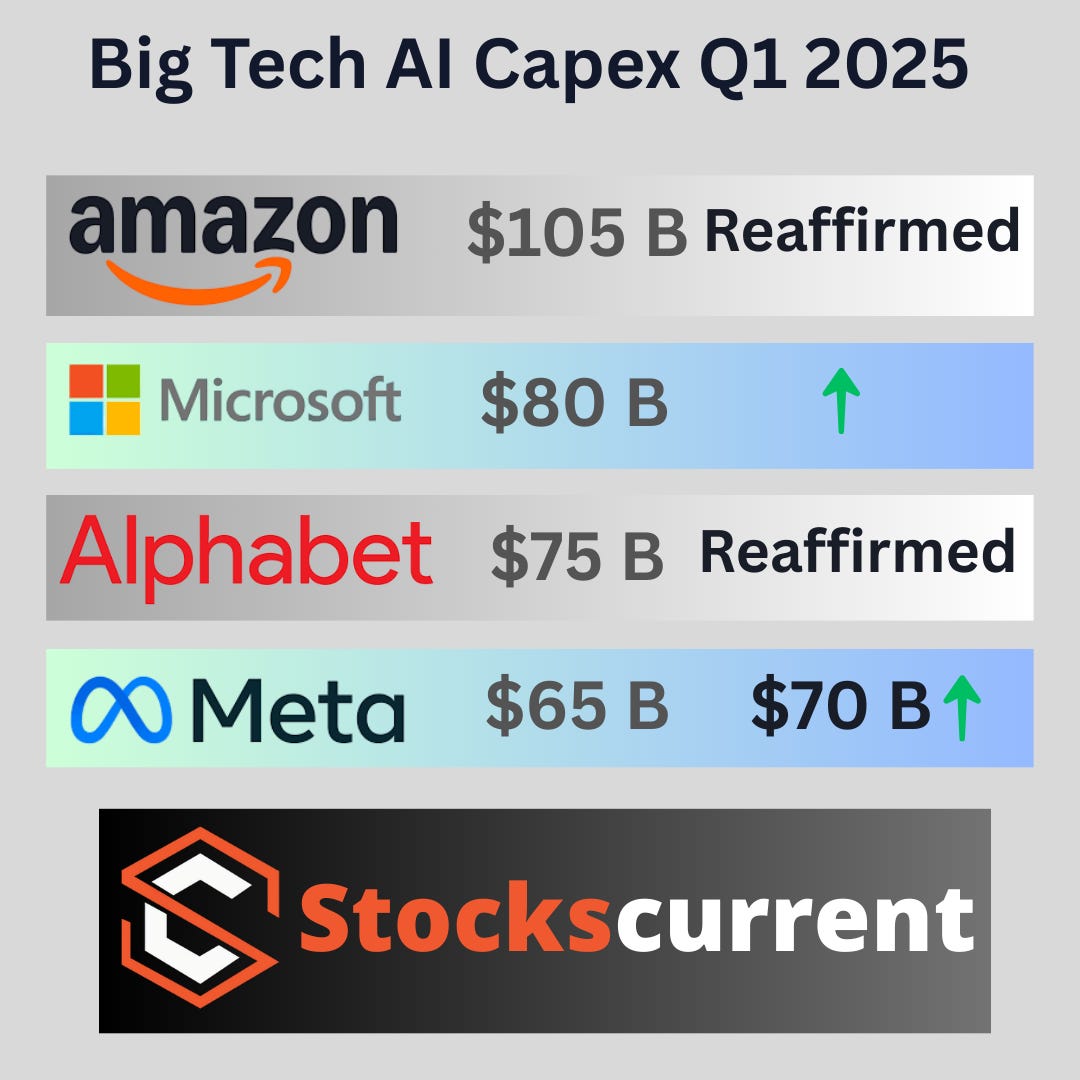
The hyperscalers' capex has reached more than $350 billion after Q1 2025.
Source: Author
Most of the capex is going for building the data centers, so-called AI factories, in the latest terms. While most people are familiar with what a data center is, few understand how it operates and its key components. We will go over those key components soon in the article. The electricity demand is continuously growing for three main reasons: electrification of everything, including electric vehicles, the second one, on-shore manufacturing, and re-industrialization; and the third reason is the build-out of data centers, which is powering AI innovations.
The major problem is that all these innovations are happening during the same period while the electrical infrastructure and grids are aging, and coming to retirement age in the US and EU. Generally, electrical infrastructure has a durability of 40-50 years, which is a long-term. According to the Department of Energy, the last time the United States experienced a significant electricity infrastructure build boom was in the 60s and 70s. Most of the electrical infrastructure improvements were made with automation and emerging technologies during the 60s and 70s. However, this infrastructure is nearing retirement. Also, 70 percent of transmission lines are over 25 years old and approaching the end of their typical 50–80-year lifecycle. This aging infrastructure is struggling to meet current needs. If the electrical infrastructure is not replaced on a one-to-one basis, there is a higher risk of electricity outages because electricity demand is growing beyond its normal rate, while electrical infrastructure and grid capabilities and resilience are decreasing, which is creating a long-term opportunity.
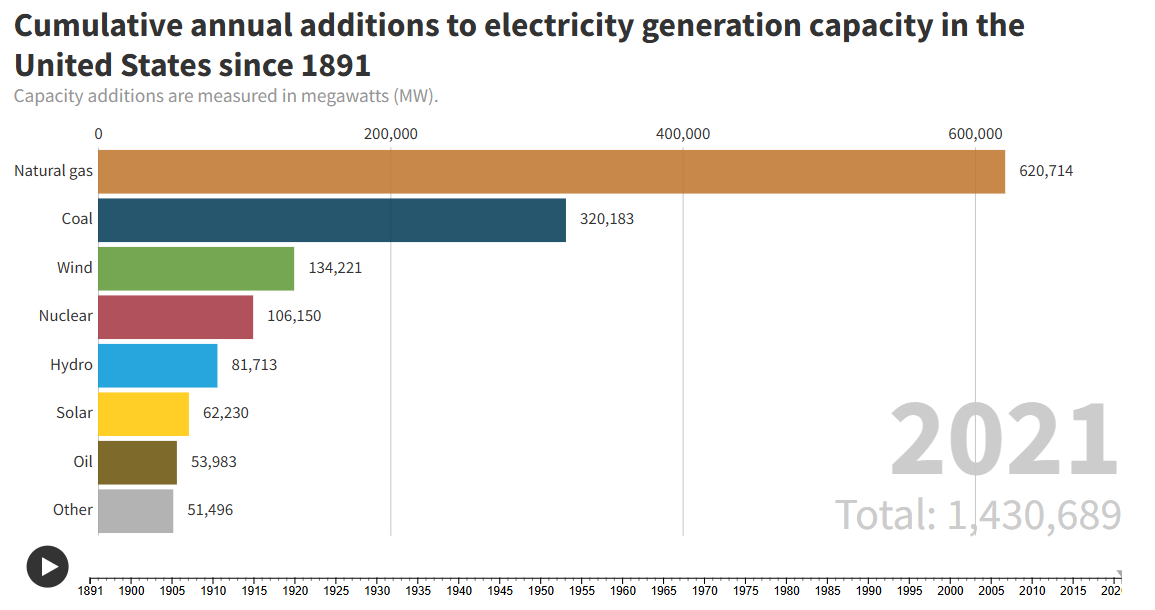
Electric vehicles, charging station infrastructure, and charging at home are putting a lot of load growth on the existing grids. Grids are already going through the stress test because of the mass adoption of electric vehicles. I firmly believe that electric vehicles will be widely adopted worldwide. That is good for the environment, but in parallel, we should also ensure that sufficient power generation, transmission, and distribution are available to support the electricity demand growth. There are new ways, such as solar panels and wind energy generation, being added to help ease the demand growth. Wind and solar are great sources, but still contribute a small percentage compared to natural gas and coal for electricity generation. In the graph below, you can see the cumulative annual additions to electricity generation capacity in the United States since 1891.
Source: U.S. Energy Information Administration
At the same time, US electricity demand experienced near-stagnant growth for 14 years, from 2008 to 2021, averaging only 0.1% annually. However, demand surged in 2024, increasing by 3.0%, making it the fifth-highest growth level this century. The major step-up function that created significant demand for electricity is data centers that power AI.
The fundamentals of Data centers:
So far, Cloud adoption and penetration have been the story that Silicon Valley tech companies were excited about. In 2021, LLM(Large Language Models) and content generation have shifted that story to the wider AI capabilities and adoption.
Data centers were running the CPUs (Central Processing Unit), and all the hyperscalers are efficiently running and maintaining the CPUs inside the data centers. With AI, they will need the GPUs(Graphics Processing Units), and Nvidia is the clear winner in the GPUs. Their latest Blackwell is selling like hot cakes.
Operating a GPU is not the same as operating a CPU; it requires much more sophisticated networking, cooling, and higher electricity. AI has been a significant inflection point. Running Large Language Models and AI workloads requires much more computing power. The industry typically uses a metric called kW per rack, which measures the electrical power consumed by the equipment installed in a rack at any given moment. Data centers with CPUs used to average somewhere between 3 and 20 kW per rack, whereas AI data centers with GPUs tend to average somewhere around 30-90 kW per rack. This means that AI data centers consume up to 10x more kW per rack than regular data centers. The higher the density within a rack, the more power it requires to operate. Nvidia's Blackwell lineup already brings a significant increase in power consumption, for the GB200 NVL72 needs 120 kW and 140 kW for the upcoming GB300 racks.
Just to put in perspective, the typical power consumed by the average US home is around 1.5 kW, meaning if consider average 60 kW per rack, the power used by a GPU rack could power more than 40 homes. No wonder some leaders and governments are starting to worry about the ability of the current electrical infrastructure to support AI.
Data center build-out backed by Big Tech AI Capex
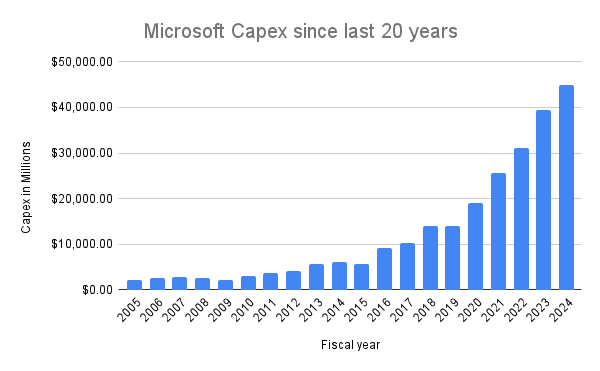
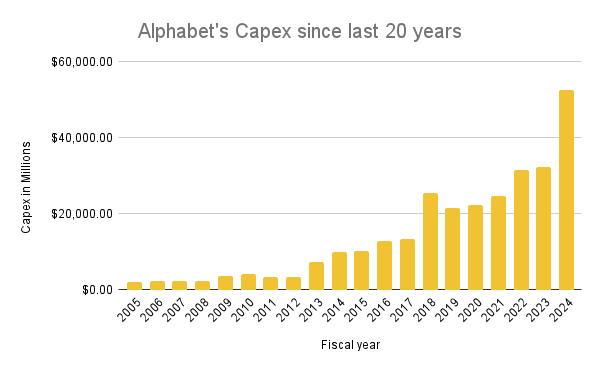
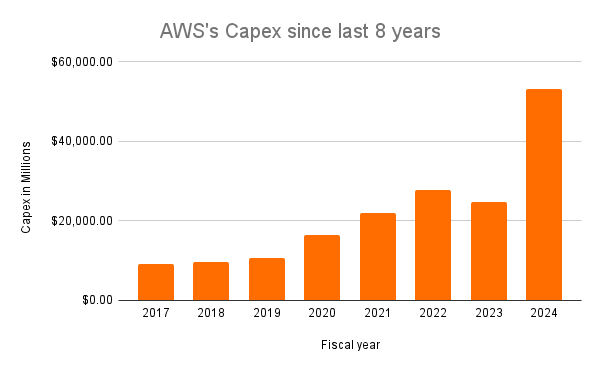
You can see that big tech capex is continuously growing. Here is the charts. You can see the capex has never decreased for hyperscalers.
Source: Author
Source: Author
Source: Author
The Hyperscalers (Amazon, Microsoft, & Google) spent more than $212 billion on CapEx over the last 12 months. We can see that there is notable uptick in the CapEx and that's the data we should not ignore.
Source: Fiscal.ai
We haven't considered other cloud companies like Oracle, Meta, XAI, and Coreweave. On top of that, there are so many AI startups that are contributing to the AI compute race. The total opportunity is even higher than expected. AI will be larger than mobile and cloud combined.
Where AI infrastructure money is spent
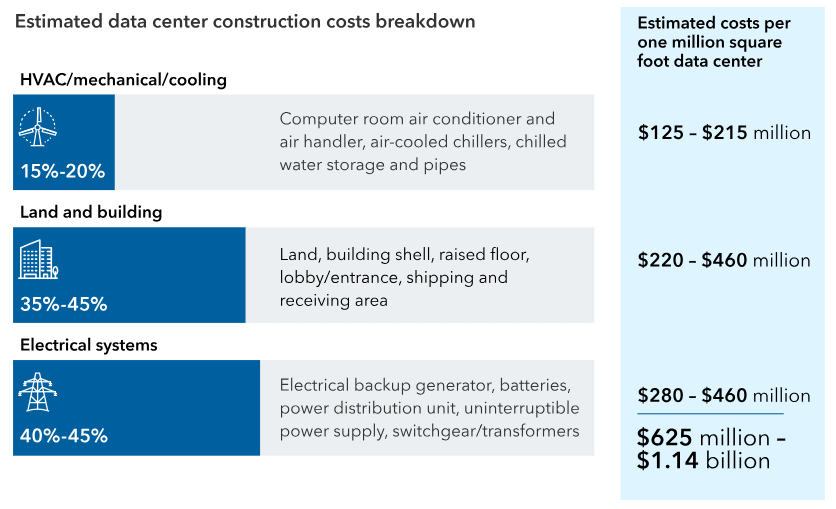
AI Data center build-outs are massive projects that require significant capital. It will be interesting to see how that money is spent. According to Capital Group, 30%-35% on land and building, 15%-20 % on cooling that includes liquid cooling and HVAC infrastructure, and 40%-45% is spent on the electric infrastructure that includes generators, grid, transformers, and switchgears. You can see in the image below.
Source: Capital Group
This continuous upgrade cycle to more powerful GPUs is likely to boost data center electricity demand further.
AI Data Center Electricity Demand Forecast
Stargate has already started building the AI factory in Abilene, Texas. For the updates on the Stargate project, please watch the video here.
For example, OpenAI's Stargate data center in Abilene, Texas, is expected to have a 1.2 GW capacity with its second phase under construction, or enough power to supply approximately 1 million homes.
As of February 2025, XAI Colossus is running a 150k GPU facility with 300 MW capacity. The facility is undergoing expansion and is expected to eventually require significantly more power, potentially reaching 1.2 to 1.4 GW. XAI is addressing the power needs through a combination of grid power and natural gas, including 35 natural gas turbines.
These are just 2 few of the biggest examples. According to the Nvidia management team on the Q1 2025 call, nearly 100 NVIDIA-powered AI factories are expected to be in motion by the end of Q1 2025. In June, CEO Jensen Huang announced 20 AI Factories in Europe, with several that are GW giga-factories during the GTC Paris event.
Source: Nvidia investor relation presentation
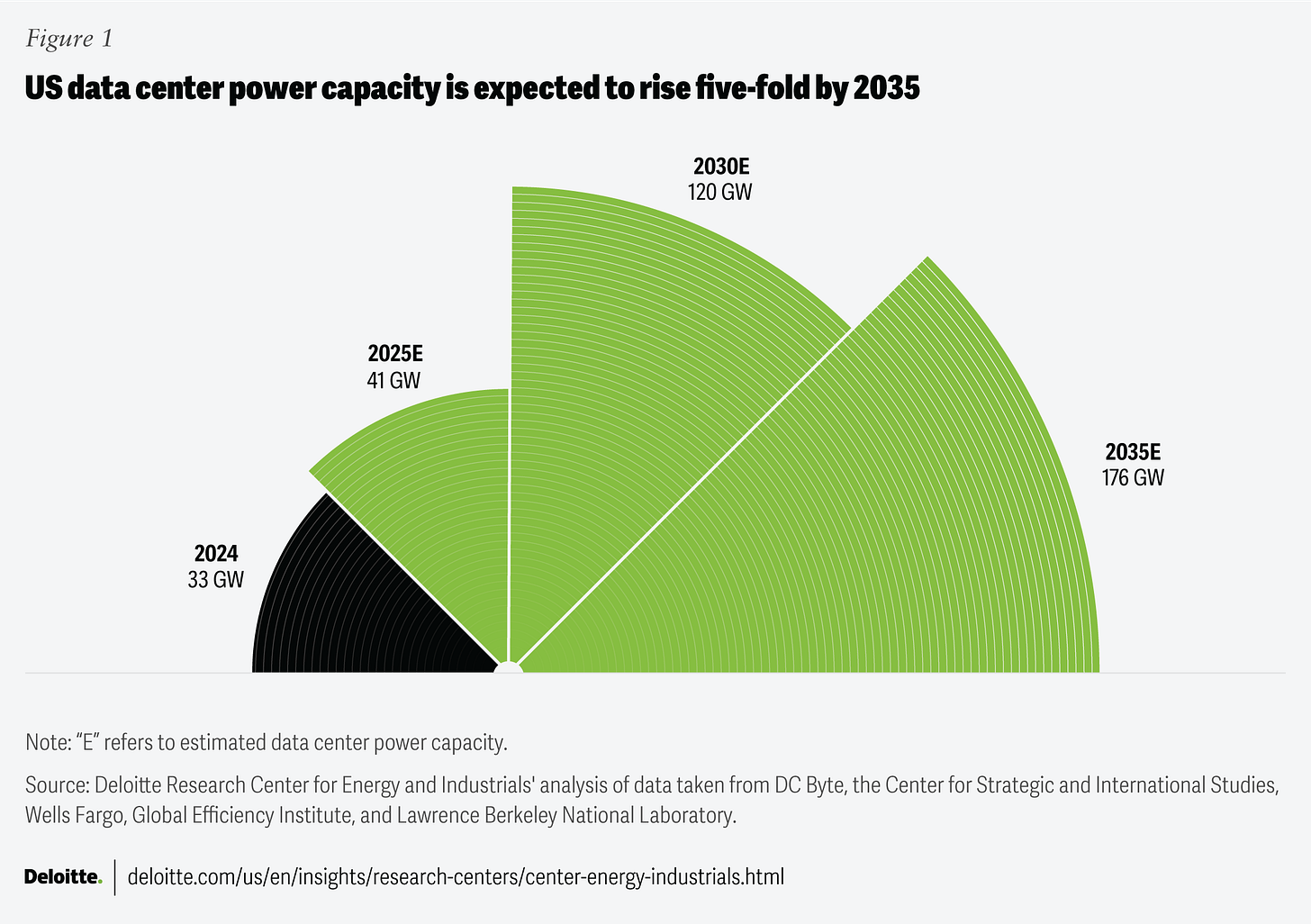
According to Deloitte, the power capacity for the US data centers is expected to grow 5x in the next 10 years.
Source: Deloitte research
Goldman Sachs Research estimates that about $720 billion of grid spending through 2030 may be needed.
Leaders are talking about the electricity bottleneck in the US.
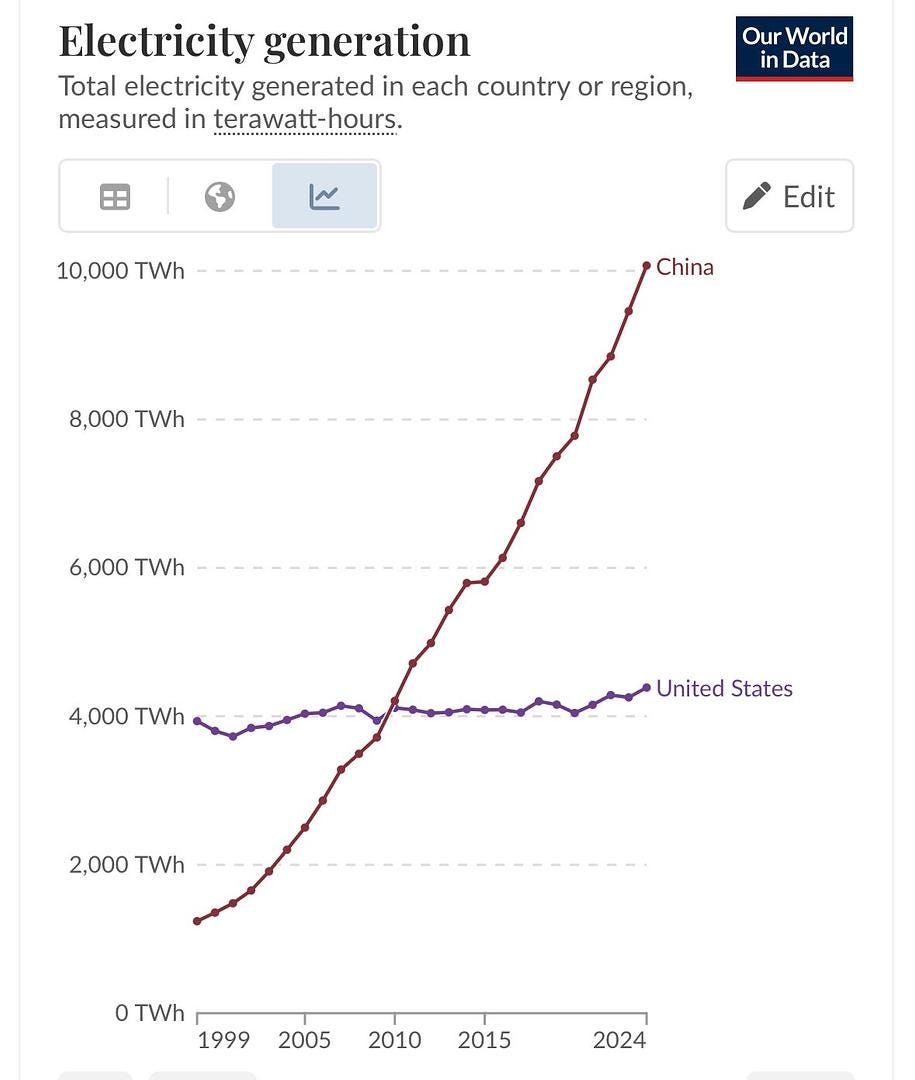
It's necessary to win the AI race. This chart shows the urgency of power generation, transmission, and distribution. You can see US electricity generation is flat while china is growing exponentially.
Many savvy leaders, including Warren Buffett, Elon Musk, Jensen Huang, former and current US presidents, Satya Nadella, Bill Gates, Andy Jessy, Sundar Pichai, Blackstone president Jon Gray, and Sam Altman, as well as the ASML management team, repeatedly emphasize the dire need for improved electricity infrastructure.
Warren Buffett has expressed concerns about the state of the US electrical grid, describing it as needing "incredible improvement" and suggesting it's akin to the interstate highway system, requiring government involvement for upgrades.
Nvidia CEO Jensen Huang also highlighted concerns during a recent call.
Most data centers are now 100 megawatts to several hundred megawatts, and we're planning on gigawatt data centers; it doesn't really matter how large the data centers are. The power is limited.
Elon Musk on electricity constraints:
"As I said a few years ago, the AI scaling constraint will move from chips to voltage transformers to electricity generation. That is worrying for US leadership in AI long-term." Now, as chip supply improves, the focus is on voltage transformers, which deliver power to AI data centers. These are hard to produce and already in short supply. The bigger issue, though, is electricity itself. Training advanced AI takes huge energy - think hundreds of megawatt-hours per run - and the US grid might not keep up - this could hurt US AI dominance.
Jon Gray, President and Chief Operating Officer of Blackstone:
"Electricity, it's probably been our biggest theme. Power, utilities, utility service companies, all sorts of business, electrical equipment, I think become increasingly exciting because of these power needs."
What makes the electrical infrastructure even more significant is that they are not being built for a single company, but for nations. Countries are betting on AI as a strategic asset.
Data center build-outs are not speculative ventures. They are massive physical infrastructure build-outs, and while timelines or plans may shift, they may delay the projects themselves, but they are not going away.
Some of the forecasts may look too lofty, but one thing is sure: it is massive and requires significant capital investment. These projects have a long timeline, which will create a long-term tailwind.
AI may look like speculation, but the need for electrical infrastructure in the US and EU is real and growing. I am currently looking into a few of the companies in the Electrical infrastructure segment.
If you like the article, please share on your social media.
Whenever you’re ready
Here’s how Stockscurrent can help you:
Stock Recommendation.
Full access to our entire library of research articles
An insight in our Portfolio full of quality stocks
Stockscurrent is helping individual investors just like you. We conduct research, provide analysis, and stock recommendations, portfolio and investment activity for long term investment. Join Stockscurrent.com along with professional and beginner investors.